
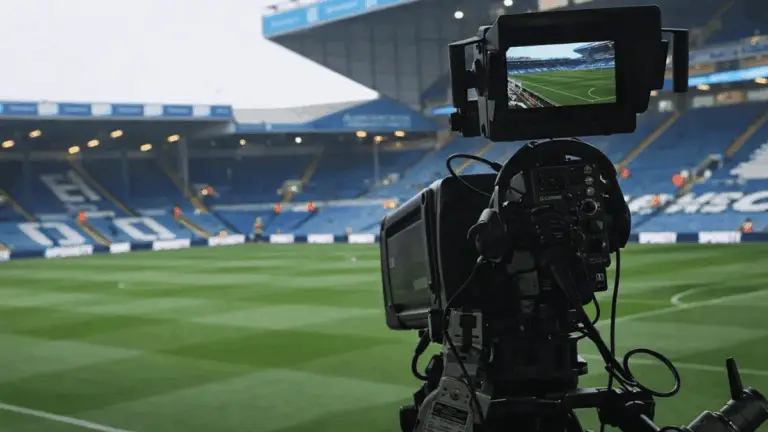
For American soccer fans, understanding Premier League TV scheduling can feel like a very different beast from US sports. Kick-off times are confirmed just weeks in advance, with matches moving to different time slots and days for a variety of reasons. If you’re used to the NFL or NBA, where the league locks in early, that can be confusing.
The Premier League operates within a complicated global broadcast setup that balances UK broadcasters, international rights holders like NBC Sports and streaming platform Peacock, and European competition commitments.
Below, we break down how the Premier League scheduling system works and why kick-off times move so frequently.
How Premier League scheduling differs from U.S. sports
God willing and the creek don’t rise, an American sports fan can pull up a chair at 7 p.m. ET most nights and know exactly what they’re getting. The NBA runs on a largely fixed schedule, with games dropping into familiar slots.
Thursday Night Football, Sunday’s triple header, and Monday Night Football are baked into the NFL calendar. Bar special occasions like Martin Luther King Day or Christmas Day, you know where and when to tune in.
The Premier League does not operate on that kind of fixed weekly rhythm. While the full fixture list is released before the season, kick-off times are provisional. Final TV selections and scheduling decisions are made just weeks in advance.
That flexibility is by design, as unlike in U.S. sports, Premier League teams compete across six different competitions, including three in Europe – The Champions League, Europa League, and Europa Conference League.
There’s also the small matter of logistical reasons, such as police operations and proximity to midweek matches on either side of the weekend.
The role of TV broadcasters in Premier League scheduling
While the Premier League releases a full fixture list before the season begins, it’s just a provisional framework. Broadcasters are given fixed windows throughout the season to make their televised selections.
Of course, not every match carries the same weight. Games involving big clubs, title contenders, European competitors, or local rivalries are more likely to be moved into prominent slots.
These selections are made in batches rather than on a game-by-game basis. Broadcasters also wait to see how the season develops, as they don’t want to commit to end-of-season games early and wind up televising a mid-table rubber match.
Recently, the Premier League moved to a system where they pick and announce televised games six weeks in advance.
For American viewers, that process matters because U.S. broadcast schedules are built on top of decisions made in the UK.
How do NBC and Peacock fit into the U.S. broadcast picture?
For US viewers, Premier League screening rights belong to NBC Sports and its streaming platform, Peacock. However, those outlets are working within a schedule that is largely dictated across the pond in the UK.
Naturally, kick-off times are set to serve the UK broadcast market first and foremost, with international broadcasters expected to adapt to those decisions.
Once UK selections are finalised, NBC and Peacock build their coverage around the available windows. Saturday’s lunchtime kick-off in the UK is shown live at 7:30am ET, while those on the West Coast will need to tune in at 4:30am to catch the Premier League action.
Because those US broadcast schedules play second fiddle to UK decisions, changes made late in the process still ripple across the Atlantic.
What is the Saturday 3pm blackout, and how does it affect US and UK viewers?
The most unusual quirk of Premier League scheduling is the Saturday 3pm blackout. It applies to the UK, but it’s irrelevant in the US. In the UK, no EPL matches are allowed to be shown live on TV between 3pm and 5:15pm GMT, hence Saturday’s televised slots being 12:30 and 5:30 GMT.
The rule is a longstanding one designed to protect in-person attendance across the Premier League and English Football League. Primarily, the broadcast rule is intended to prevent high-profile fixtures from damaging attendances for smaller clubs.
While the blackout does not apply to the US, meaning many of the UK’s 3pm games are shown in full at 10am ET, it does dictate the more inconvenient kick-off slots if you’re hoping to watch the biggest games.
Those adjusted kick-off times are then passed on to international partners, meaning U.S. viewers often inherit schedules that look less intuitive than a standard afternoon or evening start.
That constraint helps explain why Premier League Saturdays often feel spread out on U.S. television, even though there is no equivalent blackout rule in America.
Why Premier League kick-off times sometimes change late
Even once broadcast selections are confirmed, Premier League kick-off times are not completely set in stone. Change is still possible for a number of reasons. The league reserves the right to act in circumstances that can’t be determined months in advance.
Policing requirements for local rivalries, fixture congestion, and teams advancing in domestic and European cup competitions can all force adjustments to the schedule even after the TV selections have been announced.
For US viewers, the shift in start times typically mean a change in broadcast time, as opposed to a cancelled broadcast. While can be inconvenient, it’s part of a system designed to stay flexible to reach as many households as possible.